
From TPRTA Newsletter – November 2025
5. Truro Has Big Plans, Big Projects, Big Bucks, BIG Impact – Truro is at a crossroads, facing dramatic capital project proposals, transformative zoning changes, significant expansion of residential and commercial development, environmentally challenging infrastructure demands, serious threats to water supply, wastewater management and “recharging” capacity, and rapidly escalating spending and debt. If approved, these could irreversibly change Truro and ironically, make Truro unaffordable for middle-class property owners, the core of the part-time and full-time demographic.
Not only are the plans big and expensive, but the planning, design, budget and evaluation of proposals are uncoordinated, so far. Here’s a snapshot of the biggest in the works.
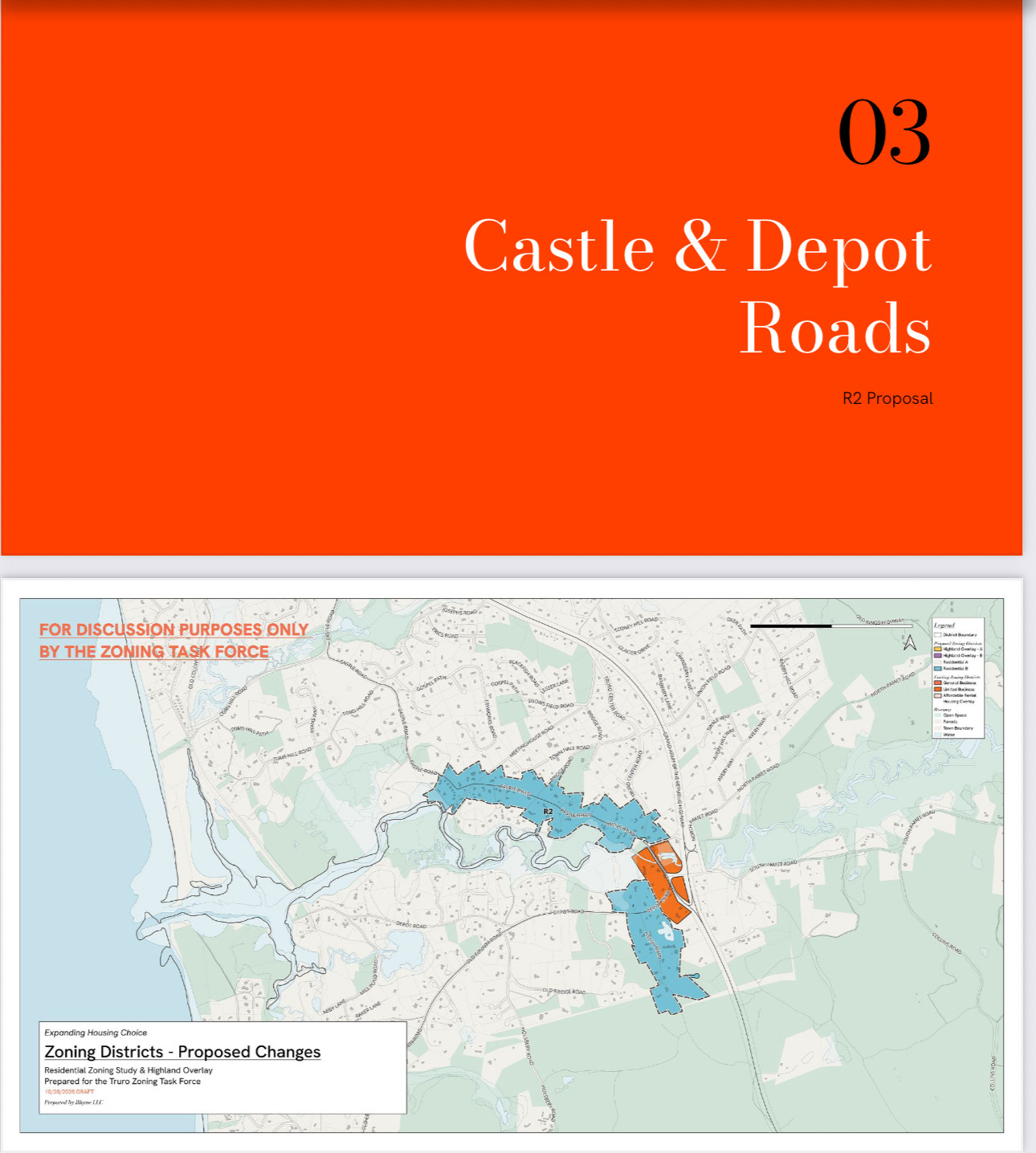
- Zoning – The Walsh Overlay District (WOD), was adopted despite fierce debate and continuing challenge about whether the simple majority vote basis was proper. Since then, the Town Zoning Task Force (ZTF) has continued to propose additional and extensive overlay districts for North Truro /Highland Overlay District (HOD) and Downtown Truro / “R2” Overlay District (ROD). If approved, these will significantly and irreversibly reshape the town density and character by allowing increases to density and building height, decreases to lot size and setbacks, non-conforming lots to become conforming by right for development, and will allow mixed use, including commercial/retail in newly created overlay zones. You can see maps for HOD and ROD here. The ZTF Chair, aware of community pushback, has said essentially, go for broke while we still operate. So, we anticipate more new Overlay Districts will be proposed. We already know that ZTF is creating “water improvement areas” that will affect septic systems of individual lots throughout Town.
- DPW – The Ad Hoc Building Committee (AHBC) proposed a new DPW design and cost framework in September, and detailed additionally in October. Full size: ~30,000 sf+, cost $32M+; “base” design, ~21,000 sf, $28M. The Select Board approved further development of “Scenario 2” at ~$28M, but we know the DPW wants the “bid alternatives” [i.e., extras]. Many of the features were proposed by the heroic (but AHBC-vilified) DPW Study Group, yet the $32M price tag has surprisingly remained the same as Weston & Sampson proposed costs for years. The Select Board and AHBC are counting on a full-court PR campaign to sway voters to accept the $28M-$32M+ price tag, but voters have been very clear: under $20M for a DPW having only three occupants daily and limited numbers of off-site staff, vehicles, and storage needs. Read More
- Water – Truro’s water challenges are impressive: Walsh / WOD sits over the main source of water for Provincetown and Truro. P’town plans to expand housing to up to 1,000 additional units and needs Truro’s water. Truro plans to expand housing in the many hundreds of units and is essentially competing for our own water. The stand-off is impressive and not resolved. But Truro knows it must address water supply and wastewater treatment. It must also reduce nitrogen loading by 25% – and the very same time it is planning to increase housing density and thus, nitrogen loading, for starters. This obvious planning conflict is serious and must be resolved. Water first.
- And then there is Provincetown and water. Provincetown, among other things, has begun to ask whether Walsh development (alone) will leave P’town without water in 50 years. The addition of plans for significant commercial development in the WOD at Walsh, never part of the reason for purchase, also burdens the fragile water source at the site. Given its own housing expansion plans, Provincetown wants certainty of water supply, including modeling the Walsh site, which Truro has (unsuccessfully) opposed. The controversy over Wash and water may limit housing inventory at Walsh to 80 units or less. If so, it is a long and hard way to get Walsh to conform to the community’s wishes expressed in 2024.
- On Truro’s water, the Board of Health (BoH) recently issued a 900-page “Comprehensive Wastewater Management Plan” (CWMP) addressing three parts of Truro’s embayments – Wellfleet Harbor, Pamet River, and East Harbor/ Provincetown Bay. The report concludes that implementing the Recommended Plan would enhance surface and groundwater quality, protect aquatic habitats, and sustain recreational and aesthetic resources. The linked four-page summary identifies a base “recommended” plan of $23.9M, with a contingency price of $59.9M. Of this, we can anticipate that up to 25% will be state-funded. The rest will be borne by taxpayers. Read More
- Then there is water infrastructure – water tower, wells, sewer and septic systems, wastewater treatment plan – all of which are largely necessary due to development expansion and zoning changes.
These also bring other costs as well – to the environment, water quality, safety, tax affordability, the social fabric of Truro, and the Town’s character, to name a few. These costs are incalculable.
- Other Capital Projects – Truro projected at ATM 2025 approximately $66M is capital improvement projects, including the DPW at about $32M. This also included about $4.2M for a voter-approved (and revenue generating) solar array project at the transfer station landfill; a $12M water tower, location TBD; and many smaller projects under $2M each. What is not included is wastewater management plans described above; plus, a likely I/A septic system upgrade for the Public Safety Facility ($400K projected), potential PFAS remediation at the transfer station (if needed) and all the unknown costs of zoning changes in proposed overlay districts. That is just what is known now. Even splitting the baby on ranges, this is $110M without debt service. With debt service taxpayers may be looking at $200M over 25 years unless voters do not approve the appropriations for these projects.
Growth is expensive and Truro taxpayers are feeling tapped out already. Rapidly accelerating Town budgets and spending are creating unsustainable tax strains now and ongoing for all residential property owners, who face stark choices if we continue to grow our budget at 5.6%, and possibly more depending on capital projects going forward.